Trunnion Mounted <a href='/tag/ball-valve' target='_blank' class='key-tag'><font><strong>ball valve</strong></font></a> for Large Diameter Pipelines: Complete Guide
Trunnion Mounted Ball Valve for Large Diameter Pipelines: Comprehensive Technical Guide
Trunnion mounted ball valves are the preferred isolation solution for large diameter, high pressure pipelines in oil and gas, petrochemical, water transmission, district heating, and power industries. This guide explains what a trunnion mounted ball valve is, how it works, why it is used in large pipeline systems, and how to specify it correctly.
1. What Is a Trunnion Mounted Ball Valve?
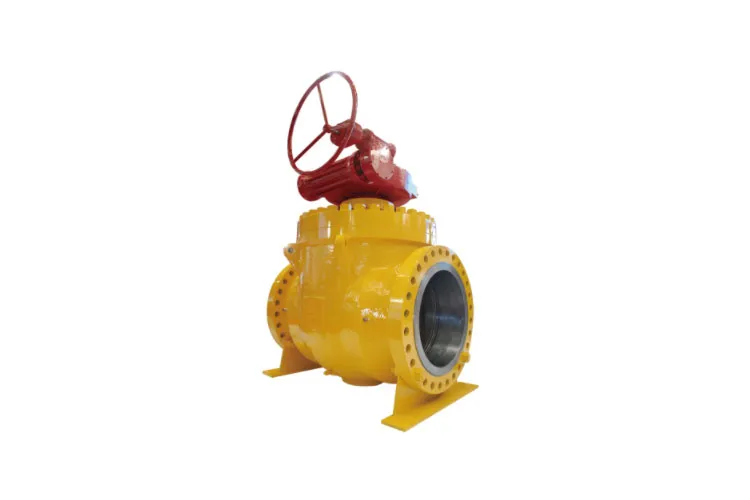
A trunnion mounted ball valve is a quarter-turn valve in which the ball is mechanically supported by trunnions (fixed shafts) at the top and bottom.
Unlike a floating ball valve, where the ball is held only by the seats, the trunnion design uses bearings or bushings to anchor the ball, allowing the valve to handle:
- Very large diameters (typically DN 150–DN 2000 and above)
- High pressures (often up to Class 2500 in some designs)
- High differential pressures with reduced operating torque
For large diameter pipelines, trunnion mounted ball valves provide reliable shut-off, low operating torque, and long service life, even under severe operating conditions and frequent cycling.
2. Why Trunnion Mounted Ball Valves for Large Diameter Pipelines?
Large diameter pipelines require valves that can handle significant internal forces, large flow volumes, and demanding operating conditions.
Trunnion mounted ball valves are favored because they combine:
- Full-bore or reduced-bore configurations for different flow requirements
- Low pressure drop to maintain pipeline efficiency
- High integrity sealing both upstream and downstream
- Low operating torque even at large sizes
- Robust mechanical support for the ball
- Suitability for automation with electric, pneumatic, or hydraulic actuators
In long-distance transmission systems, such as crude oil pipelines, natural gas pipelines, and water transmission networks,
trunnion mounted ball valves are widely used as main line block valves, sectionalizing valves, and station valves.
3. Key Components and Design Features
A trunnion mounted ball valve for large diameter pipelines consists of several critical components designed to handle high pressures, large diameters, and demanding service conditions.
3.1 Main Components
Component |
Description |
Typical Materials |
Body |
Main pressure-containing shell; can be two-piece, three-piece, or fully welded for buried service. |
Carbon steel (A105, A216 WCB), low-temp carbon steel, stainless steel, duplex SS |
Ball |
Spherical closure element that rotates 90 degrees to open or close the valve bore. |
Stainless steel, nickel-plated carbon steel, hard-coated alloy |
Trunnions |
Top and bottom shafts that support the ball and transfer loads to the body. |
Alloy steel, stainless steel, corrosion-resistant overlays |
Seats |
Sealing elements that provide tight shut-off against the ball. |
Soft seats (PTFE, RTFE, nylon, PEEK) or metal seats (Stellite, hard-coated alloys) |
Stem |
Connects actuator or lever to the ball; transmits torque. |
Stainless steel, alloy steel, high-strength carbon steel |
Gaskets and Seals |
Provide body joint and stem sealing to prevent external leakage. |
Graphite, PTFE, elastomers, metallic gaskets |
Bearings / Bushings |
Support the stem and trunnions and reduce friction. |
PTFE composites, bronze, lubricated metal bushings |
Actuator Interface |
Pad or flange designed to ISO 5211 for actuator mounting. |
Integral to body or bonnet |
3.2 Trunnion Support System
The trunnion system includes a top trunnion (integral with or connected to the stem) and a bottom trunnion (fixed shaft at the lower part of the ball).
This system:
- Resists the pressure-induced forces acting on the ball
- Reduces the load on the valve seats
- Lowers operating torque, which is critical in large diameter valves
- Allows precise alignment of the ball in the valve body
3.3 Seat Design
Common seat designs for trunnion mounted ball valves include:
- Spring-loaded seats that provide initial sealing force even at low pressure
- Pressure-energized seats that use line pressure to enhance sealing
- Double block and bleed (DBB) seat arrangements for high integrity isolation
- Soft seats for tight shut-off (often bubble-tight) in non-abrasive services
- Metal-seated designs for high temperature, abrasive, or corrosive media
4. Working Principle of Trunnion Mounted Ball Valves
A trunnion mounted ball valve operates as a quarter-turn rotary valve. The ball has a through-bore aligned with the pipeline.
4.1 Open Position
- The ball bore is aligned with the pipeline axis.
- Flow passes straight through the bore with minimal restriction.
- Seat contact is light, and friction is low.
4.2 Closed Position
- The ball is rotated 90 degrees so that the solid part of the ball faces the flow.
- Both upstream and downstream seats press against the ball.
- Flow is blocked, and tight shut-off is achieved.
4.3 Role of Trunnions in Operation
During operation in large diameter pipelines, high differential pressures can generate significant forces on the ball.
The trunnions absorb these forces and transfer them to the valve body instead of to the seats, which:
- Prevents excessive seat deformation
- Reduces the risk of seat damage during operation
- Allows large valves to be actuated with reasonable torque
5. Advantages of Trunnion Mounted Ball Valves in Large Diameter Pipelines
Using trunnion mounted ball valves in large diameter pipelines provides numerous technical and operational benefits.
5.1 Low Operating Torque
In large diameter and high pressure service, Floating ball valves can require very high torques.
Trunnion mounted ball valves significantly reduce torque requirements due to:
- Load transfer from ball to trunnions instead of seats
- Optimized seat design and sealing geometry
- Use of low-friction bearings and coatings
5.2 High Pressure and Large Size Capability
Trunnion design allows safe operation at high pressures and large diameters where other valve types may be impractical. These valves are commonly used in line sizes from:
- 6 inches (DN 150) up to 60 inches (DN 1500) and beyond
- With pressure ratings from Class 150 to Class 1500 or higher, depending on design and material
5.3 Full-Bore and Piggable Design
For long-distance pipelines, a full-bore trunnion mounted ball valve provides the same internal diameter as the pipeline. This offers:
- Low pressure drop across the valve
- Reduced turbulence and erosion
- Capability to pass pipeline pigs (cleaning, inspection, and intelligent pigs)
5.4 Tight Shut-Off and Reliable Sealing
Trunnion mounted ball valves are designed to provide bubble-tight shut-off for gas service and zero-leakage sealing for liquids when equipped with appropriate seat materials and design.
Features that support high integrity sealing include:
- Double block and bleed capability
- Fire-safe seat design and materials
- Secondary metal-to-metal sealing in case of soft seat damage
5.5 Suitability for Automation
Large diameter pipeline valves are frequently automated. Trunnion mounted ball valves are well suited to:
- Pneumatic actuators
- Hydraulic actuators
- Electro-hydraulic and electric actuators
The relatively low and predictable torque makes actuator sizing more efficient and cost-effective compared with other valve types in similar service.
5.6 Long Service Life and Low Maintenance
With proper material selection and design, trunnion mounted ball valves offer:
- Long service intervals
- Reduced risk of leakage and seat damage
- Top-entry options for in-line maintenance in some designs
- Fully welded body options for buried and subsea pipelines
6. Typical Applications in Large Diameter Pipelines
Trunnion mounted ball valves are widely used as primary isolation valves in various large diameter pipeline systems.
6.1 Oil and Gas Transmission Pipelines
- Crude oil trunk lines
- Refined product pipelines
- Natural gas transmission pipelines
- Condensate and NGL lines
6.2 Petrochemical and Chemical Pipelines
- Feedstock supply lines to refineries and petrochemical complexes
- Long-distance chemical product pipelines
- Industrial plant utility pipelines
6.3 Water and Wastewater Transmission
- Large diameter potable water transmission mains
- Raw water supply lines for power plants and industrial plants
- Desalinated water transmission pipelines
- Wastewater and effluent trunk lines (with appropriate materials)
6.4 District Heating and Cooling
- Hot water and steam distribution networks
- Chilled water distribution pipelines
6.5 Power Generation and Industrial Utilities
- Cooling water supply and return lines
- Fuel gas and fuel oil supply lines
- Fire water mains and ring mains
7. Body Styles for Large Diameter Trunnion Mounted Ball Valves
Various body constructions are available to suit installation location, maintenance strategy, and pipeline design.
7.1 Split Body (Two-Piece or Three-Piece)
- Commonly used in above-ground installations
- Body is bolted together and can be disassembled for maintenance
- Suitable for a wide range of sizes and pressure classes
7.2 Fully Welded Body
- Preferred for buried and subsea pipelines
- Eliminates body joint leakage paths
- Provides higher structural integrity
- Requires careful planning for maintenance, as body cannot be easily opened
7.3 Top-Entry Body
- Allows access to internal components from the top without removing the valve from the pipeline
- Often used where in-line maintenance is required
- Suitable for large diameter high-pressure service
8. Soft-Seated vs Metal-Seated Trunnion Mounted Ball Valves
The seat type for a trunnion mounted ball valve in large diameter pipelines is chosen based on media, temperature, and service conditions.
8.1 Soft-Seated Trunnion Ball Valves
Soft seats are typically made from polymeric materials and provide:
- Very tight sealing (often bubble-tight)
- Low torque and smooth operation
- Good performance in clean fluids and gases
Common soft seat materials include:
- PTFE and reinforced PTFE
- R-PTFE for improved temperature and wear resistance
- PEEK or nylon for higher temperature and pressure capabilities
8.2 Metal-Seated Trunnion Ball Valves
Metal seats are used where:
- High temperature service exceeds soft seat capability
- Abrasive or dirty media may damage soft seats
- Fire-safe or severe service conditions are present
Metal seats may incorporate:
- Hard-facing overlays such as Stellite
- Carbide coatings and special alloys
Although metal-seated trunnion mounted ball valves may have slightly higher torque and may not always achieve bubble-tight sealing in all applications,
they offer excellent durability and reliability in harsh conditions.
9. Double Block and Bleed (DBB) Function
In long-distance pipelines and critical process lines, the double block and bleed function is highly desirable.
Many trunnion mounted ball valves for large diameter applications are designed to provide this function.
9.1 DBB Principle
- The valve has two independent seating surfaces that can seal against pressure from either side.
- A bleed or drain connection is provided in the body cavity between the seats.
- When closed, both upstream and downstream seats can isolate the valve body cavity from line pressure.
9.2 Benefits of DBB Trunnion Ball Valves
- Enhanced isolation for maintenance and safety
- Ability to verify seat tightness by monitoring bleed connection
- Reduction in the number of valves required to achieve double isolation
10. Common Materials for Large Diameter Trunnion Mounted Ball Valves
Material selection is a critical step in specifying trunnion mounted ball valves for large diameter pipelines.
The materials must be compatible with the fluid, pressure, temperature, and environmental conditions.
10.1 Typical Body and Bonnet Materials
Material |
Common Designation |
Typical Application |
Carbon Steel |
ASTM A105, A216 WCB |
General oil and gas, water, non-corrosive service |
Low-Temperature Carbon Steel |
ASTM A350 LF2, A352 LCB/LCC |
Low temperature and cryogenic applications |
Stainless Steel |
ASTM A182 F304/F316 |
Corrosive fluids, seawater, chemical service |
Duplex Stainless Steel |
ASTM A182 F51/F53/F55 |
High chloride, sour service, offshore |
Alloy Steel |
ASTM A182 F11/F22 |
High temperature, steam service |
10.2 Seat and Seal Materials
Seat / Seal Material |
Characteristics |
Typical Use |
PTFE / R-PTFE |
Low friction, chemical resistance, limited temperature |
Clean liquids and gases, general process service |
PEEK |
High temperature and pressure capability |
High pressure gas, higher temperature liquids |
Nylon |
Good wear resistance, moderate temperature |
Water, hydrocarbons, multiphase fluids |
Metal / Hard-Faced |
Excellent wear and temperature resistance |
Abrasive, high-temperature, or severe service |
Graphite |
High temperature sealing, fire-safe |
Stem packing, body gaskets for fire-safe designs |
11. Pressure Classes and Sizes for Large Diameter Trunnion Mounted Ball Valves
Trunnion mounted ball valves are manufactured in a wide range of sizes and pressure classes to suit large diameter pipelines.
11.1 Typical Size Range
Nominal Diameter (DN) |
Nominal Pipe Size (NPS) |
Application Segment |
150–300 |
6″–12″ |
Plant headers, manifold lines |
350–600 |
14″–24″ |
Medium pipelines, main process lines |
650–900 |
26″–36″ |
Transmission pipelines, trunk lines |
950–1500 |
38″–60″ |
Long-distance pipelines, water transmission |
>1500 |
>60″ |
Special large diameter pipeline projects |
11.2 Typical Pressure Class Range
ASME Class |
Typical Use |
Class 150 |
Low pressure water, low pressure oil and gas pipelines |
Class 300 |
Medium pressure oil and gas, refinery pipelines |
Class 600 |
High pressure transmission pipelines, critical services |
Class 900–1500 |
High pressure gas, offshore, and severe services |
12. End Connections for Large Diameter Trunnion Mounted Ball Valves
End connection type impacts installation, maintenance, and pipeline integrity.
12.1 Flanged Ends
- Common for above-ground installations
- Available in RF (raised face), RTJ (ring-type joint) configurations
- Facilitates easy removal and replacement
12.2 Butt-Weld Ends
- Preferred for buried or high integrity lines
- Provides strong, leak-resistant connection when properly welded
- Requires precise welding procedure and inspection
12.3 Hub and Other Specialty Ends
- Used in offshore and subsea systems
- Compatible with connector systems specific to subsea operations
13. Standards and Certifications
Large diameter trunnion mounted ball valves are typically designed and manufactured to conform to international valve and pipeline standards.
13.1 Design and Manufacturing Standards
- API 6D – Specification for Pipeline and Piping Valves
- ASME B16.34 – Valves – Flanged, Threaded, and Welding End
- ISO 17292 – Metal Ball Valves for Petroleum, Petrochemical and Allied Industries
13.2 Testing Standards
- API 598 – Valve Inspection and Testing
- API 6D – Specifies hydrostatic and seat leakage test requirements
13.3 Fire-Safe and Safety-Related Standards
- API 607 / API 6FA – Fire test for soft-seated valves
- ISO 10497 – Fire type-testing requirements
14. Typical Technical Specification Table
The following sample specification table illustrates typical parameters to consider when selecting a trunnion mounted ball valve for large diameter pipelines.
Actual values depend on project requirements and valve design.
Parameter |
Typical Specification |
Valve Type |
Trunnion mounted ball valve, full bore, bidirectional |
Size Range |
DN 150 (6″) to DN 1500 (60″) and above |
Pressure Rating |
ASME Class 150–1500 (or equivalent PN ratings) |
Body Material |
Carbon steel, stainless steel, duplex, or alloy steel |
Ball and Stem Material |
Stainless steel or plated/high alloy carbon steel |
Seat Material |
Soft seat (PTFE, R-PTFE, PEEK, nylon) or metal seat |
End Connection |
Flanged (RF/RTJ), butt-weld, or specialized hubs |
Design Standard |
API 6D, ASME B16.34, ISO 17292 |
Face-to-Face |
ASME B16.10 or API 6D dimensional standards |
Testing Standard |
API 598, API 6D hydrostatic and seat tests |
Fire-Safe Design |
Tested to API 607 / API 6FA or ISO 10497 |
Operation |
Manual gear, pneumatic actuator, hydraulic actuator, electric actuator |
Temperature Range |
Depending on materials, typically from -46 °C to +200 °C or higher |
Sealing Arrangement |
Double block and bleed capability (optional) |
Stem Sealing |
Multiple packing rings, anti-blowout stem design |
Special Features |
Antistatic device, emergency sealant injection, drain and vent connections |
15. Selection Considerations for Large Diameter Trunnion Mounted Ball Valves
Choosing the right trunnion mounted ball valve for a large diameter pipeline requires evaluating multiple technical parameters.
15.1 Process Conditions
- Fluid type (oil, gas, water, chemical, multiphase)
- Presence of solids, wax, sand, or other particulates
- Operating pressure and maximum differential pressure
- Operating and design temperature range
15.2 Functional Requirements
- On/off isolation vs throttling (trunnion ball valves are mainly for isolation)
- Required leakage class and tightness
- Double block and bleed requirement
- Fire-safe and emergency shutdown (ESD) requirements
15.3 Mechanical and Installation Considerations
- Above-ground vs buried installation
- Horizontal vs vertical orientation
- Availability of space for actuator and maintenance
- Pipeline design pressure and diameter
15.4 Material and Corrosion Considerations
- Corrosion allowance and selection of corrosion-resistant alloys
- Compatibility with fluid composition (CO2, H2S, chlorides)
- Need for internal coatings or overlays
15.5 Actuation and Control
- Frequency of operation and required speed of closure
- Availability of power sources (compressed air, hydraulic power, electricity)
- Fail-safe position requirements (fail-open or fail-closed)
- Need for remote monitoring and control via SCADA or DCS
16. Maintenance and Operation Best Practices
To maximize the reliability and life of trunnion mounted ball valves in large diameter pipelines, several best practices should be followed.
16.1 Regular Inspection
- Inspect for external leakage at body joints and stem packing.
- Verify valve operation torque and compare to design values.
- Monitor actuator performance and control signal response.
16.2 Seat and Stem Sealing Management
- Use emergency sealant injection systems as recommended for critical valves.
- Maintain stem packing integrity and adjust as needed.
- Follow recommended replacement intervals for soft seals.
16.3 Cleaning and Protection
- Ensure that pipeline commissioning includes proper flushing to remove debris.
- Avoid operating valves with foreign objects trapped between ball and seats.
- Maintain protective coatings on valve exterior for corrosion protection in harsh environments.
17. Safety and Fire-Safe Considerations
Large diameter pipeline valves are critical safety components. Trunnion mounted ball valves often incorporate:
- Anti-blowout stem design to prevent stem ejection under pressure
- Fire-safe construction with metal-to-metal backup sealing
- Antistatic devices to prevent static discharge across the ball and stem
- Locking devices to prevent accidental operation
Fire-safe trunnion mounted ball valves are designed such that, in case of soft seat damage due to fire,
the metal seat ring and ball can still provide secondary sealing to limit leakage.
A trunnion mounted ball valve for large diameter pipelines is a robust, high performance isolation device
designed to handle very high pressures, large line sizes, and demanding operating environments.
Its mechanical design, with the ball supported by trunnions, makes it especially suitable for:
- Long-distance oil and gas transmission pipelines
- Large diameter water and district heating lines
- Critical process and utility systems in industrial plants
When correctly specified with appropriate body, seat, and seal materials, end connections,
and actuation methods, trunnion mounted ball valves provide:
- Reliable tight shut-off
- Low pressure drop
- Low operating torque and ease of automation
- Long service life with minimal maintenance
For engineers and pipeline designers working with large diameter pipelines, understanding
the design features, material options, standards, and application requirements of trunnion mounted ball valves
is essential for achieving safe, efficient, and cost-effective pipeline operation.
“`






 Phone