
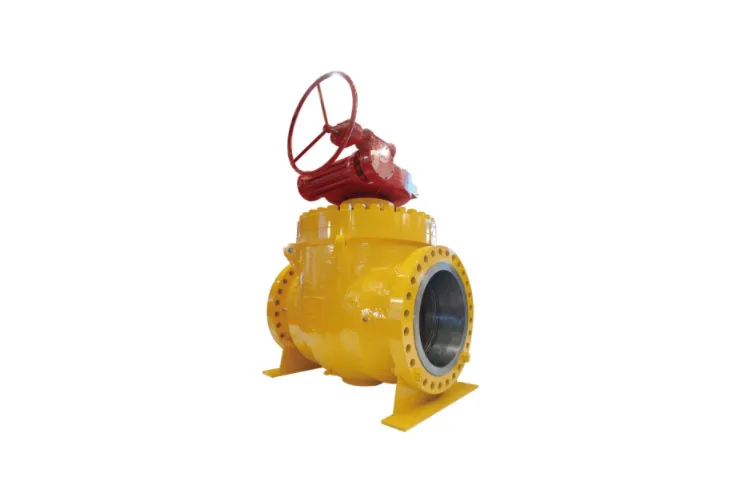
Industrial Top Entry Flow Control ball valve
The industrial Top Entry Ball Valve, also known as a top-mounted ball valve, is a critical device for pipeline flow control. Its core function is achieved by rotating the ball, which is loaded from the top, 0°–90° to regulate the flow and on/off control of the medium. It is suitable for demanding conditions, including high pressure, high temperature, and media containing particles, and is widely used in industries such as oil, chemical, and natural gas. The following sections outline its structure, working principle, advantages, applications, and key performance parameters.
Core Structure and Working Principle
Structural Design: The valve features an integrated body, with the ball, seats, stem, and other internal components loaded from the top. It incorporates a double block and bleed structure, stem blowout protection, double O-ring seals, and fire-safe packing. Some models include anti-static grounding and sealant injection ports.
Control Principle: The flow area is regulated by rotating the ball (0°–90°). When the bore aligns with the pipeline, the valve is fully open; when perpendicular, it is fully closed. The rotational angle corresponds to the flow rate. V-shaped ball designs allow an adjustable range of up to 300:1, with accuracy of ±1%, making it suitable for precise flow control applications.

Key Advantages in Flow Control
Efficient Maintenance: Internal components can be serviced online without removing the valve from the pipeline, reducing downtime and leakage risk, ideal for buried or confined installations.
Reliable Sealing: Metal-to-metal seals (e.g., tungsten carbide) handle high pressure and temperature, while soft seals (PTFE, etc.) resist corrosive media. Bi-directional sealing meets ISO 15848 Class B, and fire-safe design complies with API 607 standards.
High Adaptability: Rated for Class 150–2500 (PN10–PN420) pressure, wide temperature range up to 800°C, and capable of handling media with particles or abrasive materials.
Easy Operation: Low torque design, compatible with manual, pneumatic, or electric actuators, supports remote automation control, and includes emergency manual override for safety.
Typical Applications
Oil & Gas: High-pressure flow regulation and emergency shut-off in long-distance pipelines and LNG facilities, suitable for high-pressure and low-temperature environments.
Chemical & Metallurgy: Flow control of acids, alkalis, high-temperature gases, and particle-containing media (e.g., ash, pulp), with metal seals resisting wear and corrosion.
Power & Energy: Flow control of steam, heat transfer oil, and other media, with fire- and explosion-proof design for hazardous environments.
Municipal & Pulp & Paper: Urban heating pipelines and pulp transport systems, enabling online maintenance to minimize downtime.
Key Performance Parameters
Pressure Rating: Class 150–2500 (PN10–PN420), suitable for high-pressure systems.
Temperature Range: -196°C to 800°C (depending on materials).
Leakage Class: ISO 15848 Class B; some metal-to-metal seals achieve zero leakage.
Flow Characteristics: V-shaped ball allows a 300:1 adjustable ratio, linear or equal percentage flow control, adaptable to various control requirements.
Contact Person:Max.Song(SongShanshan)
Title:General Manager
Mobile:+86 15611322632
Tell:+86 10 89282693
Email:international@bvmc.com
Address:No. 3, Lvhai Road, Pangezhuang Town, Daxing District, Beijing


Copyright © Beijing Valve General Factory Co., Ltd.
SitemapThis website uses cookies to ensure you get the best experience on our website.




 Phone
Phone