Fixed <a href='/tag/ball-valve' target='_blank' class='key-tag'><font><strong>ball valve</strong></font></a> Standards: API and ISO Overview
Fixed Ball Valve Standards: API and ISO Overview
Fixed ball valves, often referred to as trunnion-mounted ball valves, are critical components in modern
pipeline and process systems. This comprehensive overview explains the major API and ISO standards that
govern fixed ball valves, including design, materials, testing, and performance requirements. The focus is
on universally applicable industry information without reference to specific brands or manufacturers.
1. Introduction to Fixed Ball Valves
Fixed ball valves are quarter-turn shut-off valves designed to provide reliable isolation in high-pressure,
large-diameter, and demanding service conditions. Unlike floating ball valves, where the ball is held in
place by the seats, a fixed ball valve uses a trunnion or shaft support at the top and bottom of the ball.
This design significantly reduces operating torque and seat wear, making fixed ball valves suitable for
critical applications in oil and gas, petrochemical, power generation, and general industrial service.
International standards from bodies such as the American Petroleum Institute (API) and the International
Organization for Standardization (ISO) define the design rules, dimensions, materials, testing methods, and
documentation requirements for fixed ball valves. Understanding these standards helps engineering,
procurement, and maintenance teams specify, compare, and qualify valves for safe and reliable operation.
2. What Is a Fixed (Trunnion-Mounted) Ball Valve?
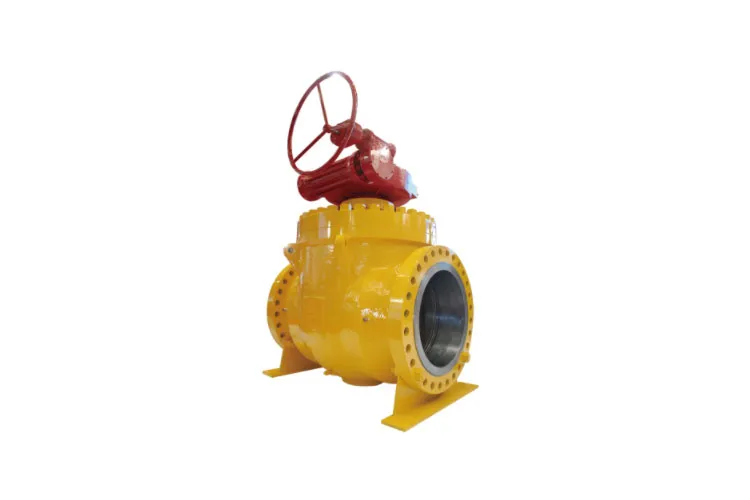
A fixed ball valve, commonly called a trunnion-mounted ball valve, is a ball valve in which the ball is
mechanically supported by shafts or trunnions at two points. The ball does not float downstream under
pressure; instead, the seat rings are energized to move toward the ball and create a tight seal.
2.1 Key Characteristics
- Ball is supported by upper and lower trunnions or shafts.
- Seat rings are spring-loaded or pressure-energized.
- Lower operating torque compared to Floating ball valves.
- Suitable for high-pressure and large-diameter pipelines.
- Available in soft-seated and metal-seated configurations.
- Commonly designed to API and ISO ball valve standards.
2.2 Typical Applications
- Transmission pipelines for crude oil and natural gas.
- Refinery and petrochemical process units.
- Offshore and subsea production systems.
- Power generation (steam, gas, and combined cycle plants).
- Industrial utility services where tight shutoff is required.
3. Advantages of Fixed Ball Valves
Fixed ball valves are widely specified due to their performance, reliability, and operational benefits. The
advantages become especially important in high-pressure and large-bore services where maintenance and
downtime are costly.
3.1 Operational Advantages
-
Reduced Operating Torque:
The trunnion support eliminates the need for the ball to move against the seats under pressure, which
lowers torque and allows smaller actuators or easier manual operation.
-
Consistent Seal Performance:
Spring-energized or pressure-energized seats maintain a reliable seal over a wide range of pressures and
temperatures.
-
Bidirectional Sealing:
Many fixed ball valves, designed according to API and ISO standards, provide tight shutoff in both flow
directions.
-
Long Service Life:
Reduced seat wear and optimized load distribution around the ball contribute to extended valve service
intervals.
3.2 Safety and Environmental Advantages
-
Low Fugitive Emissions:
Compliance with emission standards such as ISO 15848 parts 1 and 2 or API 641 helps reduce leakage from
stems and body joints, supporting environmental and safety goals.
-
Fire-Safe Design:
Many fixed ball valves are tested to API 607, ISO 10497, or similar fire-safe standards, ensuring
sealing integrity during and after fire exposure.
-
Double Block and Bleed (DBB):
Trunnion-mounted ball valves are often used in DBB configurations, allowing pipeline isolation and
cavity venting for maintenance and safety checks.
3.3 Economic and Maintenance Advantages
-
Lower Actuation Costs:
Lower torque requirements minimize actuator size and energy consumption for automated systems.
-
Reduced Downtime:
Robust design and standardized parts lead to fewer unplanned shutdowns and easier maintenance planning.
-
Standardization Benefits:
Conformance to recognized API and ISO standards simplifies qualification, inspection, and global
procurement.
4. Overview of API and ISO Standards for Fixed Ball Valves
Fixed ball valves are governed by multiple overlapping and complementary standards. The most widely
referenced are produced by API and ISO, which cover design, dimensions, testing, fire safety, and fugitive
emissions. Selecting a valve that complies with these standards ensures compatibility, safety, and
consistent performance.
4.1 Major API Standards Relevant to Fixed Ball Valves
API Standard |
Title / Scope |
Relevance to Fixed Ball Valves |
API 6D |
Specification for Pipeline Valves |
Defines design, manufacturing, testing, and documentation requirements for trunnion-mounted ball
valves used in pipeline service.
|
API 608 |
Metal Ball Valves – Flanged, Threaded and Welding Ends |
Specifies requirements for metal ball valves in general refinery and petrochemical service,
including trunnion-mounted designs.
|
API 607 |
Fire Test for Quarter-Turn Valves and Valves Equipped with Nonmetallic Seats |
Establishes fire-safe test methods and acceptance criteria for quarter-turn valves, commonly applied
to fixed ball valves.
|
API 6FA |
Specification for Fire Test for Valves |
Alternative fire test standard often used in pipeline and wellhead environments. |
API 598 |
Valve Inspection and Testing |
Covers pressure testing and inspection procedures applicable to many metal valves, including fixed
ball valves where specified.
|
API 641 |
Low Emission Valves – Fugitive Emissions Type Testing |
Defines type testing requirements to demonstrate low fugitive emissions performance. |
4.2 Major ISO Standards Relevant to Fixed Ball Valves
ISO Standard |
Title / Scope |
Relevance to Fixed Ball Valves |
ISO 17292 |
Metal Ball Valves for the Petroleum, Petrochemical and Allied Industries |
Central ISO standard for ball valves, including trunnion-mounted designs, covering design,
testing, and marking.
|
ISO 5208 |
Industrial Valves – Pressure Testing of Valves |
Provides general rules and leakage rate classifications for valve pressure testing. |
ISO 14313 |
Petroleum and Natural Gas Industries – Pipeline Transportation Systems – Pipeline Valves |
International equivalent to API 6D for pipeline valves, including fixed ball valves. |
ISO 10497 |
Testing of Valves – Fire Type-Testing Requirements |
Fire type-testing procedures for valves, widely applied to ball valves with nonmetallic seats. |
ISO 15848-1/2 |
Industrial Valves – Measurement, Test and Qualification Procedures for Fugitive Emissions |
Defines test methods and classification for low-emission valve performance. |
In many projects, a fixed ball valve may be designed according to both API 6D and ISO 14313, or according
to ISO 17292 with supplementary API requirements. Understanding the hierarchy and cross-references between
these standards is essential for accurate specification.
5. Design Features of Fixed Ball Valves under API and ISO Standards
API and ISO standards define critical design aspects of fixed ball valves to ensure safety, functionality,
and interchangeability. Although the detailed calculations and formulas are contained within the
standards, the following highlights the most important design features governed by these documents.
5.1 Pressure and Temperature Ratings
Fixed ball valves are assigned pressure–temperature ratings based on material groups and end-connection
standards. Typical references include ASME B16.34 for steel valves and ASME B16.5 or B16.47 for flanges. API
6D and ISO 14313 incorporate these ratings for pipeline valves.
Pressure Class (ASME) |
Common Use in Fixed Ball Valves |
Typical Applications |
Class 150 |
Low to medium pressure pipeline and process service |
District heating, low-pressure oil and gas, water distribution |
Class 300 |
Medium pressure process and transmission lines |
Refinery units, midstream gas, chemical plants |
Class 600 |
High-pressure pipeline sections and critical services |
High-pressure gas transmission, offshore platforms |
Class 900 and above |
Very high-pressure and specialized services |
Subsea tiebacks, high-pressure injection, critical isolation |
5.2 Body Construction Types
Fixed ball valves are available in several body constructions, all of which must meet the strength and
leak-tightness requirements specified in API 6D, API 608, and ISO 17292.
5.3 Seat Design and Cavity Relief
In trunnion-mounted ball valves, the seat rings are typically spring-loaded and pressure-energized. API 6D
and ISO 17292 require that valves be designed to prevent overpressure in the body cavity, often achieved
through:
- Self-relieving seats that allow overpressure in the cavity to push the seat away from the ball.
- Dedicated cavity relief valves that vent pressure to a safe location.
- Compliance with double block and bleed or double isolation and bleed configurations where specified.
5.4 Stem and Anti-Blowout Features
API and ISO ball valve standards mandate that the valve stem be designed to prevent blowout under pressure.
This is usually accomplished by:
- Inserting the stem from inside the valve body.
- Using retainer rings or collars under the packing area.
- Ensuring sufficient stem-to-ball engagement to transmit torque safely.
Additional stem design features may include live-loaded packing and stem extension options for low
temperature or underground installations.
6. Materials for Fixed Ball Valves in API and ISO Standards
Material selection is fundamental to safe and long-lasting performance. API and ISO standards specify
permissible body, ball, stem, and trim materials, along with heat treatment and impact testing requirements.
6.1 Common Body and Bonnet Materials
Material |
Standard Designation (Typical) |
Service Characteristics |
Carbon Steel |
ASTM A216 WCB, A105 |
General-purpose material for moderate temperatures and non-corrosive to mildly corrosive fluids. |
Low-Temperature Carbon Steel |
ASTM A350 LF2, A352 LCB |
Improved toughness at low temperatures, suitable for cryogenic or low-temperature service. |
Stainless Steel |
ASTM A351 CF8M, A182 F316 |
Good corrosion resistance, commonly used in chemical and offshore applications. |
Duplex Stainless Steel |
ASTM A995 Grade 4A, A182 F51 |
High strength and excellent resistance to chloride stress corrosion cracking. |
Alloy Steel |
ASTM A217 WC6, WC9 |
High-temperature and high-pressure service, such as power generation. |
6.2 Ball, Stem, and Trim Materials
The ball and stem materials are selected to balance strength, corrosion resistance, and galling resistance.
Hard-facing or overlay materials may be applied to seating surfaces for severe service.
- Ball: Typically stainless steel or alloy steel; may be hard-coated (e.g., chromium
carbide, tungsten carbide) for erosive or high-cycle applications.
- Stem: High-strength stainless or alloy steel; surface treatments can improve wear and
corrosion resistance.
- Seats: Soft seats (PTFE, reinforced PTFE, PEEK) or metal seats with hard-facing for
high-temperature or abrasive service.
6.3 Sealing and Packing Materials
Seat and packing materials significantly influence valve performance, especially regarding emissions,
fire-safety, and temperature resistance. Common materials include:
- PTFE and filled PTFE for general-purpose, low-friction soft seats.
- PEEK for higher temperature and improved chemical resistance.
- Elastomers (e.g., NBR, FKM) for O-rings, depending on media compatibility.
- Graphite packing and gaskets for fire-safe designs and high-temperature applications.
7. Dimensional and End Connection Requirements
API and ISO fixed ball valve standards define critical dimensions to ensure compatibility with piping
systems. These include face-to-face dimensions, end connection types, and bore configurations.
7.1 Face-to-Face Dimensions
Face-to-face (or end-to-end) dimensions are generally standardized according to ISO 5752, ASME B16.10, or
related dimensional standards referenced by API 6D and ISO 17292. This allows interchangeability between
valves from different manufacturers as long as they comply with the same standard.
7.2 End Connection Types
End Connection |
Description |
Typical Use with Fixed Ball Valves |
Flanged |
Raised face or ring-type joint flanges per ASME B16.5 or B16.47. |
Common for process and pipeline connections where repeated disassembly may occur. |
Butt-Weld |
Welded directly to pipeline according to ASME B16.25. |
Preferred for buried pipelines, high-pressure lines, and permanent installations. |
Socket-Weld |
Smaller sizes; welding into a socket end. |
Used in compact piping systems for smaller diameters and higher pressures. |
Threaded |
Pipe threads (e.g., NPT, BSP) for low-pressure applications. |
Less common in large fixed ball valves; used mainly for small bore or utility service. |
7.3 Bore Configurations
API 6D and ISO 14313 specify bore sizes suitable for piggable pipeline valves, making full-bore fixed ball
valves the standard choice for many transmission systems.
8. Testing and Inspection Requirements
Testing is central to both API and ISO standards for fixed ball valves. These tests verify that valves meet
the required integrity, tightness, and performance criteria before installation in the field.
8.1 Hydrostatic and Pneumatic Testing
Hydrostatic shell and seat tests are required by API 6D, API 598, ISO 5208, and ISO 17292. Typical tests
include:
ISO 5208 and API 598 classify allowable leakage rates. For many critical applications, fixed ball valves
must meet very tight leakage limits (such as zero visible leakage).
8.2 Functional Testing
In addition to pressure testing, API and ISO standards may require:
- Operational testing across the full stroke to confirm torque, smoothness, and correct orientation.
- Verification of position indicators and any locking devices.
- Testing of actuator–valve assemblies where supplied as a complete unit.
8.3 Fire Testing
Fire-safe certification is commonly mandated in hydrocarbon service. Fire testing according to API 607,
API 6FA, or ISO 10497 verifies that a fixed ball valve can maintain acceptable leakage levels when exposed
to fire and subsequent cooling.
- Nonmetallic seat and sealing materials are tested for fire resistance.
- Valve integrity under elevated temperature and thermal shock is confirmed.
- Post-fire operability and leakage performance are assessed.
8.4 Fugitive Emissions Testing
To address environmental regulations, many fixed ball valves are type-tested to fugitive emission
standards:
- ISO 15848-1 and ISO 15848-2 set test sequences and leakage limits for stem and body joints.
- API 641 provides a specific low-emission test protocol, focusing on methane or hydrocarbon leaks.
Meeting these standards ensures that fixed ball valves contribute to reduced emissions and regulatory
compliance.
9. Fixed Ball Valve Selection Criteria Based on API and ISO Standards
Selecting a fixed ball valve for a given application involves more than choosing a size and pressure class.
API and ISO standards provide guidance that can be translated into practical selection criteria.
9.1 Basic Sizing Parameters
Selection Parameter |
Considerations for Fixed Ball Valves |
Nominal Size (DN / NPS) |
Match to pipeline or process line; full-bore valves preferred for pigging. |
Pressure Class |
Determine from design pressures, temperature, and applicable ASME or EN ratings. |
Temperature Range |
Ensure body, trim, and sealing materials are compatible with minimum and maximum temperatures. |
Media Type |
Consider chemical compatibility, toxicity, abrasiveness, and presence of solids or contaminants. |
9.2 Functional and Safety Requirements
- Determine whether double block and bleed or double isolation and bleed
is required.
- Check if fire-safe certification according to API 607 or ISO 10497 is mandatory.
- Assess fugitive emissions limits and specify ISO 15848 or API 641 testing where
needed.
- Identify need for emergency sealant injection systems on seats and stem.
- Confirm compatibility with actuation (manual, gear, pneumatic, hydraulic, or electric
actuators).
9.3 Environmental and Installation Conditions
- For buried or underground valves, ensure suitable coatings, extended stems, and actuator arrangements.
- For offshore environments, consider corrosion resistance and protective coatings as guided by offshore
design standards.
- For cryogenic or very low temperatures, evaluate compliance with low-temperature testing and materials
requirements.
10. Comparison: Fixed vs. Floating Ball Valves under API and ISO
Understanding the difference between fixed (trunnion-mounted) and floating ball valves helps in correct
standard-based selection.
Parameter |
Fixed (Trunnion-Mounted) Ball Valve |
Floating Ball Valve |
Ball Support |
Ball supported by trunnions at top and bottom. |
Ball held in place by seat rings; free to move downstream. |
Typical Size Range |
Medium to large diameters (e.g., NPS 2 and above). |
Smaller diameters; commonly used up to medium sizes. |
Pressure Capability |
Suitable for higher pressures and larger pressure classes. |
Typically used for lower to medium pressures. |
Operating Torque |
Lower torque due to independent seat movement. |
Higher torque as the ball must move against the seats. |
Seat Wear |
Reduced seat wear, longer service life. |
Potential for higher seat wear due to ball movement. |
Standards Coverage |
Covers trunnion-mounted designs in API 6D, API 608, ISO 14313, ISO 17292. |
Covered by the same standards but with different internal support configuration. |
In standardized specifications, the choice between fixed and floating ball valves depends on pressure,
diameter, and service criticality. API and ISO standards allow both types but emphasize trunnion-mounted
designs for high-integrity pipeline applications.
11. Sample Specification Table for Fixed Ball Valves (API / ISO Based)
The following example shows how key parameters for fixed ball valves can be presented in a specification
table for project or catalog use. Values are illustrative and must be confirmed against specific project
requirements and applicable standards.
Parameter |
Example Specification |
Notes / Standard Reference |
Valve Type |
Fixed (Trunnion-Mounted) Ball Valve |
Quarter-turn valve for on/off service. |
Design Standard |
API 6D / ISO 14313 |
For pipeline applications; ISO 17292 for process service. |
Size Range |
NPS 2 – 48 (DN 50 – 1200) |
Typical range; may vary by design. |
Pressure Classes |
ASME Class 150 – 1500 |
Defined per ASME B16.34 and flange standards. |
End Connections |
Flanged RF / RTJ; Butt-Weld |
According to ASME B16.5, B16.47, B16.25. |
Bore Type |
Full Bore (Full Port) |
Suitable for piggable pipeline service. |
Body Material |
Carbon Steel ASTM A216 WCB / Stainless Steel ASTM A351 CF8M |
Selection based on media and design temperature. |
Ball and Stem Material |
Stainless Steel ASTM A182 F316 or equivalent |
Enhanced corrosion resistance and strength. |
Seat Material |
PTFE / RPTFE / PEEK / Metal |
Soft or metal seats depending on service conditions. |
Fire-Safe Design |
Yes, tested to API 607 / ISO 10497 |
Required for hydrocarbon and hazardous service. |
Fugitive Emissions |
Tested to ISO 15848-1 / API 641 (where specified) |
Low-emission packing and design. |
Face-to-Face Dimensions |
Per ASME B16.10 / ISO 5752 |
Ensures dimensional interchangeability. |
Testing |
Hydrostatic and pneumatic per API 6D / ISO 5208 |
Shell and seat tests with defined leakage rates. |
Operation |
Lever, Gear, or Actuator Operated |
Top flange per ISO 5211 for actuator mounting in many designs. |
Temperature Range |
-29 °C to +200 °C (example) |
Depends on materials and seat selection. |
Coating / Protection |
External paint or coating system suitable for environment |
Corrosion protection tailored to onshore or offshore use. |
12. Documentation and Compliance for Fixed Ball Valves
API and ISO standards not only address the physical design of fixed ball valves but also define
documentation and quality assurance requirements. These help ensure traceability and compliance throughout
a valve’s lifecycle.
12.1 Typical Documentation Package
- Material test certificates complying with EN 10204 or equivalent (e.g., 3.1 or 3.2).
- Pressure test reports per API 6D, API 598, or ISO 5208.
- Fire test and fugitive emissions certificates where applicable.
- Dimensional inspection records and non-destructive examination reports.
- Assembly drawings, parts lists, and operating manuals.
12.2 Quality and Manufacturing Standards
Many end-users require that manufacturers of fixed ball valves operate quality management systems certified
to ISO 9001. Additional certifications, such as ISO 14001 (environmental) and ISO 45001 (occupational
health and safety), may also be considered in project specifications.
13. Frequently Asked Questions about Fixed Ball Valve Standards
13.1 Are fixed ball valves always designed to API 6D?
Fixed ball valves used in transmission pipelines are usually designed to API 6D or its international
equivalent ISO 14313. However, trunnion-mounted valves for refinery, petrochemical, or general industrial
service may instead follow API 608 and ISO 17292. The appropriate standard depends on the application and
project specification.
13.2 Do all fixed ball valves require fire-safe certification?
Fire-safe certification is typically required in hydrocarbon and hazardous service. For benign media such
as water or non-flammable fluids, fire-safe testing may not be mandatory. Project specifications determine
whether compliance with API 607, API 6FA, or ISO 10497 is required.
13.3 How do API and ISO standards address fugitive emissions?
Fugitive emissions requirements are defined mainly by ISO 15848-1/2 and API 641. These standards set test
conditions, number of operating cycles, and leakage limits. Many fixed ball valves are designed with
advanced stem packing systems and body seals to meet these criteria.
13.4 Is a full-bore fixed ball valve always needed for pipelines?
Full-bore fixed ball valves are preferred for piggable pipelines so that inspection and cleaning devices
can pass through. In non-piggable systems or process lines, reduced-bore designs may be acceptable if
pressure drop and flow characteristics remain within design limits.
Fixed (trunnion-mounted) ball valves play a central role in modern pipeline and process systems. API and ISO
standards provide a comprehensive framework for the design, manufacturing, testing, and qualification of
these valves. By specifying valves that comply with established standards such as API 6D, API 608, ISO
17292, and ISO 14313, engineering and procurement teams can ensure high levels of safety, reliability, and
regulatory compliance.
When evaluating or specifying fixed ball valves, it is advisable to consider not only size and pressure
rating but also materials, end connections, sealing technology, fire-safety requirements, and fugitive
emission performance. Leveraging API and ISO requirements as a common reference point simplifies
comparison, improves system compatibility, and supports long-term operational efficiency.
“`






 Phone