
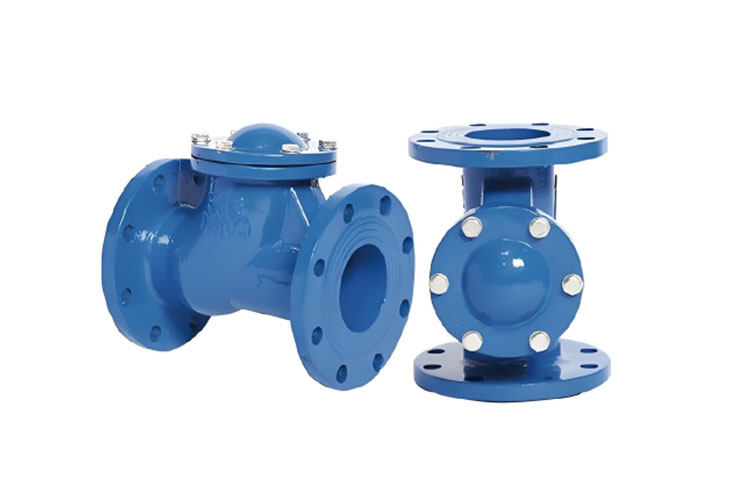
Power Station Specific Ball Check Valve
Power station-specific ball check valves are non-return valves specially designed for thermal and nuclear power plant systems. They are intended for high-temperature, high-pressure media such as steam and feedwater. Featuring a ball-shaped disc and heavy-duty construction, these valves rely on line pressure to drive the disc to open and close automatically. They provide the core advantages of reliable sealing, strong impact resistance, and high temperature and pressure tolerance, effectively preventing reverse flow that could damage critical equipment such as boilers and pumps, thereby ensuring the safe and stable operation of power plant systems.
The structural design is tailored for the demanding conditions of power plants. The valve body is made from high-strength materials such as WC6/WC9 chromium–molybdenum alloy steel or P91/P92 heat-resistant steel. It is manufactured through integral forging, with wall thickness designed according to ASME B16.34 and GB/T 12224 standards, providing resistance to thermal shock and stress deformation under high temperature and pressure. The ball-shaped disc is solid-forged from austenitic stainless steel and solution-treated to enhance high-temperature stability. The sealing surface is overlay welded with Stellite 6 or cobalt-based hardfacing alloys (hardness ≥ HRC 58), providing excellent wear resistance and high-temperature oxidation resistance.

The valve seat adopts a metal hard-sealing structure combined with a spring preloading mechanism, automatically compensating for thermal expansion and wear at high temperatures, achieving leakage performance in accordance with ANSI B16.104 Class V. Built-in damping devices and a streamlined flow path design significantly reduce water hammer. The stem is made from 25Cr2MoV alloy structural steel, quenched, tempered, and nitrided, and together with flexible graphite packing, ensures zero leakage under high temperature and high pressure.
Key technical parameters include nominal sizes from DN25 to DN800 (1"–32"), pressure ratings from PN16 to PN420 (Class 150 to 2500 LB), and an operating temperature range of 200 °C to 650 °C. High-temperature models made from Inconel alloys can withstand extreme temperatures up to 800 °C. Connection types include flanged ends (in accordance with ASME B16.5 and GB/T 9113) and butt-welded ends, making the valve suitable for power plant piping systems. Manufacturing and testing strictly follow standards such as API 598, DL/T 992 (power plant valve standard), and GB/T 12224, including high-temperature pressure tests, sealing performance tests, and non-destructive examinations (UT/RT).
In terms of performance, the valve offers three major advantages. First, it provides excellent temperature and pressure resistance: the material and structural design are suitable for high-temperature, high-pressure steam and feedwater, ensuring long-term operation without deformation. Second, it offers smooth opening and closing: the ball-shaped disc and damping mechanism provide fast response with minimal impact, with a flow resistance coefficient ≤ 0.4 and low pressure drop. Third, it delivers high reliability: the metal sealing surfaces and wear-compensation structure withstand frequent operation and media erosion, resulting in long service life. These valves are suitable for boiler feedwater pipelines, main steam pipelines, condensate systems, and circulating water systems, and are typically used in thermal power plants, nuclear power stations, and combined heat and power (CHP) units. They are key valves for ensuring one-way flow and the safe operation of power plant equipment.
Contact Person:Max.Song(SongShanshan)
Title:General Manager
Mobile:+86 15611322632
Tell:+86 10 89282693
Email:international@bvmc.com
Address:No. 3, Lvhai Road, Pangezhuang Town, Daxing District, Beijing


Copyright © Beijing Valve General Factory Co., Ltd.
SitemapThis website uses cookies to ensure you get the best experience on our website.




 Phone
Phone